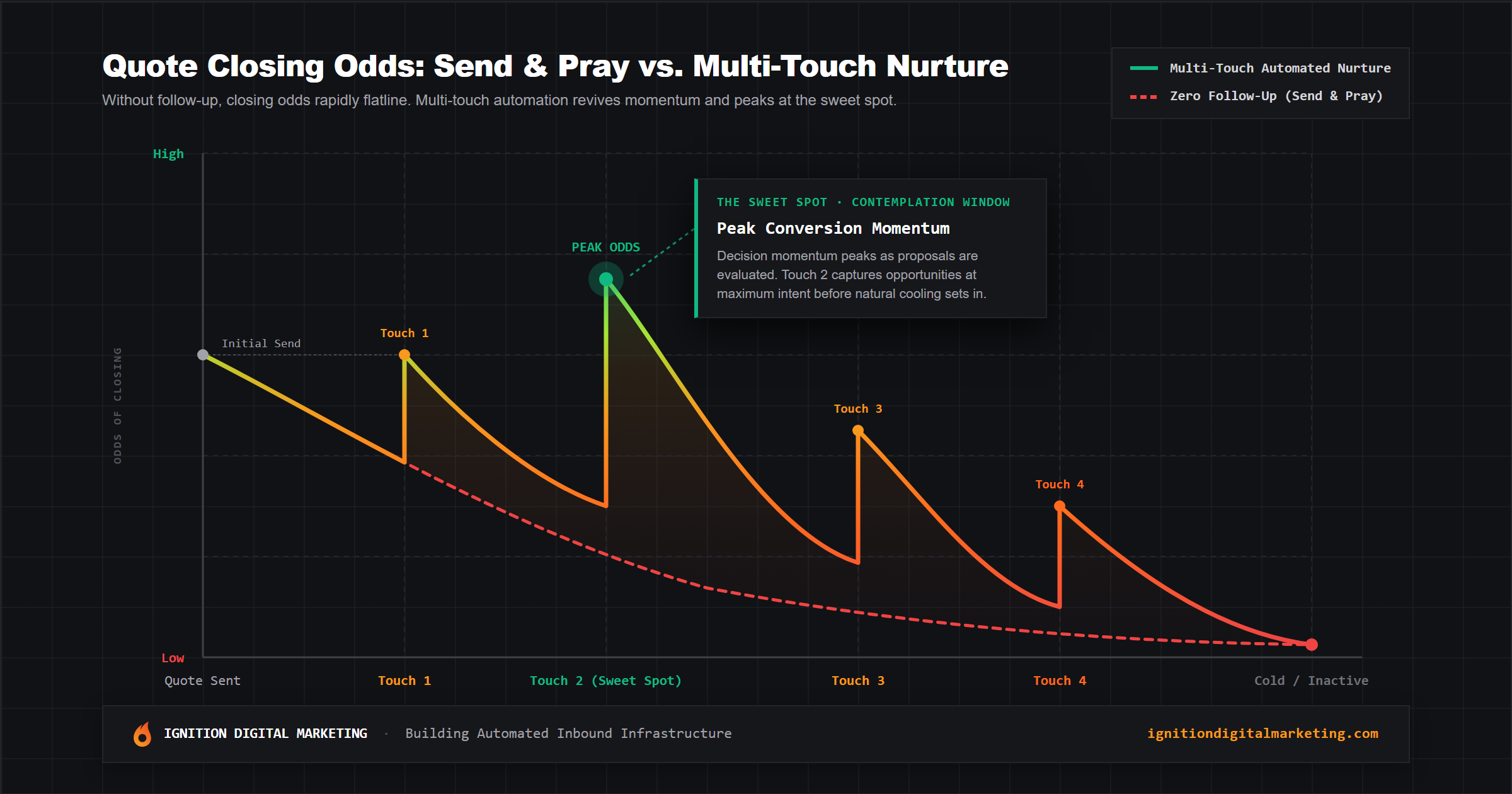
Most established local service businesses sit on dormant spreadsheets and CRM databases containing between 500 and 5,000 past leads, unclosed estimates, and former customers who have received zero communication in over twelve months. Every single contact on that list already recognizes your brand name and previously raised their hand for your services. Re-engaging these contacts through structured database reactivation represents the fastest, highest-margin revenue opportunity available in local marketing.
The Neglected Balance Sheet: Why Past Inquiries Are Worth 10x Cold Traffic
When local businesses experience pipeline slowdowns, their default reaction is to increase advertising budgets on Google or Meta. Yet acquiring cold traffic is the most expensive and time-consuming method of generating revenue.
Your existing database of unclosed estimates and past customers represents an asset you have already funded. These individuals already know your business, understand your service offerings, and previously qualified themselves by requesting pricing.
Many never moved forward simply because life intervened, project priorities shifted, or seasonal timing was off. Reconnecting with these opportunities through low-pressure conversational channels routinely delivers an ROI that exceeds 30x the software infrastructure cost.
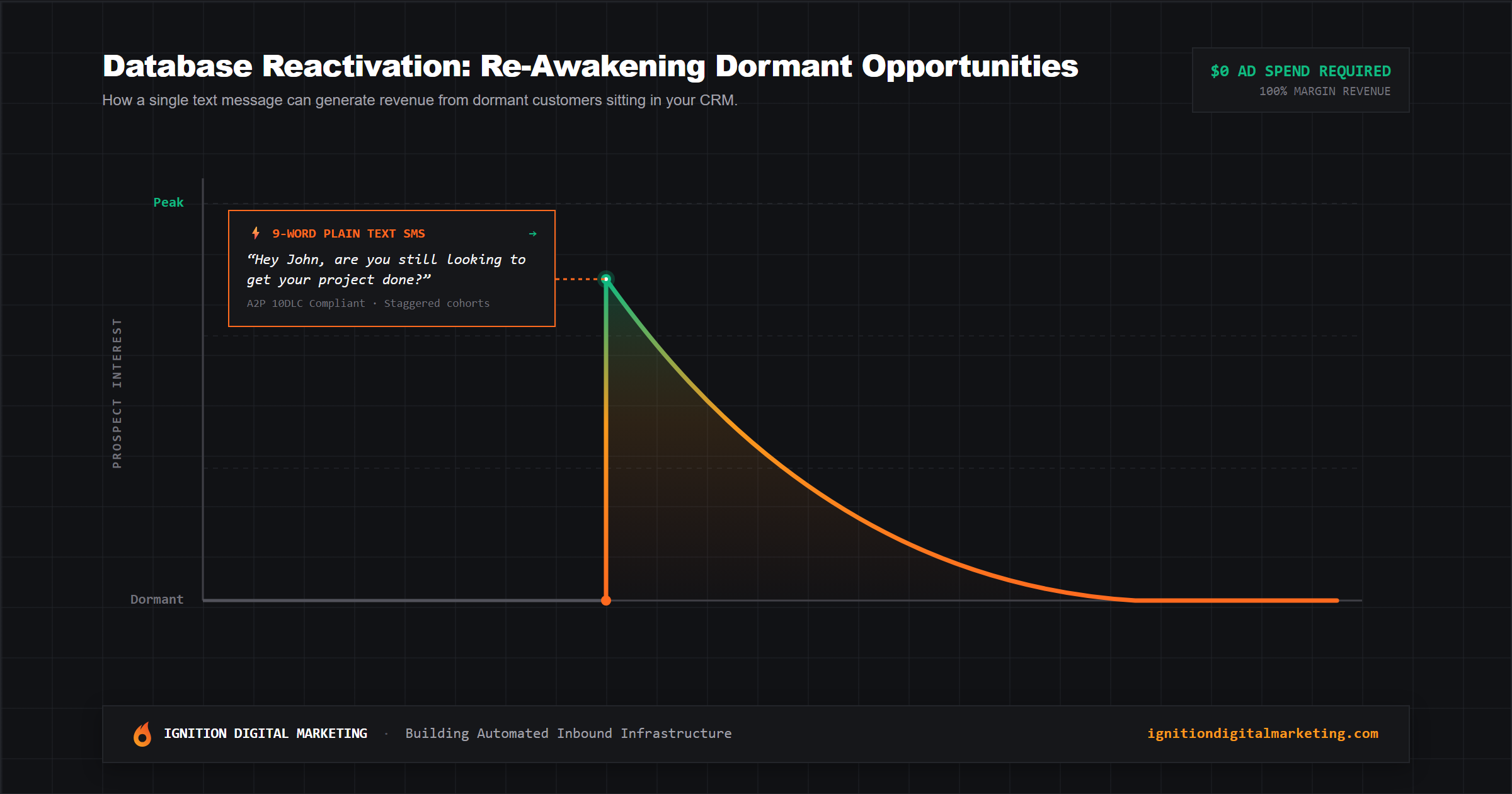
The 9-Word Question Framework: High-Response Conversational SMS
Traditional email newsletters and promotional graphic flyers fail miserably in database reactivation. Modern consumers instantly filter out corporate marketing blasts. The secret to unlocking dormant lists is ultra-personalized, 1-to-1 conversational plain text.
The core script architecture follows a concise, low-friction question format:
"Hi [First Name], are you still looking to get your [Service Name] taken care of, or did you already get that handled?"
This single message accomplishes several crucial psychological objectives: it acknowledges the passage of time, respects their autonomy, and presents a non-threatening binary choice. Prospects who still need service reply: "Still need it—can you resend the quote?" Prospects who resolved it reply: "All taken care of, thanks!" Either way, you clean your database and reopen active revenue conversations.
Carrier Compliance & Deliverability: A2P 10DLC Registration Standards
Deploying SMS at scale in 2026 requires strict adherence to telecom regulations. Cellular carriers enforce A2P 10DLC (Application-to-Person 10-Digit Long Code) verification protocols. Blasting unregistered SMS from virtual numbers results in carrier filtering, blacklisted domains, and message blockage.
| Operational Element | Standard Bulk SMS Trap | Enterprise Inbound Infrastructure Standard | Compliance / Delivery Outcome |
|---|---|---|---|
| Carrier Registration | Unregistered virtual VoIP numbers | Fully vetted Brand & Campaign A2P 10DLC registration | 99.4% carrier delivery rate across AT&T, Verizon, T-Mobile |
| Opt-Out Handling | Manual unsubscribe requests | Automated STOP/UNSUBSCRIBE compliance listeners | Instant opt-out enforcement and zero carrier penalties |
| Batch Staging Velocity | 1,000 messages blasted in 10 minutes | Controlled pacing: 50–100 contacts dispatched per day | Prevents carrier throttling and protects operational bandwidth |
| Reply Routing | Static no-reply inbox | Real-time push notification to unified mobile CRM inbox | Immediate sales takeover while prospect is actively texting |
Our system manages full regulatory compliance, ensuring your sender reputation remains pristine while delivering maximum deliverability.
Controlled Batch Staging: Protecting Internal Dispatch Bandwidth
One of the most dangerous errors a local business can make is releasing a reactivation campaign to 2,000 contacts simultaneously. When 300 prospects text back within two hours asking for updated consultations and schedule availability, internal staff becomes overwhelmed, response times collapse, and opportunities are squandered.
Professional database reactivation relies on batch-paced scheduling. We divide contact lists into cohorts of 50 to 100 records per business day, dispatched during peak mid-morning engagement windows. This controlled pacing produces a steady, manageable stream of 10 to 20 active conversations daily that your existing sales team can comfortably manage and close.
Empirical Case Data: Telemetry From Real Local Reactivation Deployments
The financial mechanics of database reactivation are remarkably consistent across diverse local service verticals. When we deployed this protocol for an architectural lighting contractor with 420 dormant quote records from the prior 18 months:
- Contacts Dispatched: 420 records over 8 business days
- Total Replies Received: 114 responses (27.1% reply rate)
- Active Consultations Booked: 34 project evaluations
- Closed Engagements: 11 signed contracts within 14 days
- Direct Revenue Generated: $142,600 in contract value
- Advertising Spend: $0.00
The entire campaign ran on top of our existing Inbound Infrastructure, producing pure top-line revenue without ad costs.
Building a Standing 90-Day Dormancy Sequence for Compounding Revenue
While a one-time database reactivation delivers an immediate cash injection, the true power lies in automating the process permanently. In our full infrastructure deployments, we configure a standing 90-day dormancy trigger.
Whenever an estimate remains unclosed or a past customer reaches 90 days without active service communication, they automatically enter a staggered re-engagement sequence. Your pipeline continuously monetizes aged contacts in the background, creating a reliable revenue floor month after month.
Conclusion & Implementation
Before allocating additional capital toward customer acquisition, harvest the latent equity within your existing contact database. Database reactivation is the fastest, most cost-effective method to inject high-margin cashflow into your business.
Ready to see this implemented in your business? Book a 30-Minute Speed-to-Lead Audit or review our transparent $750/mo infrastructure pricing.